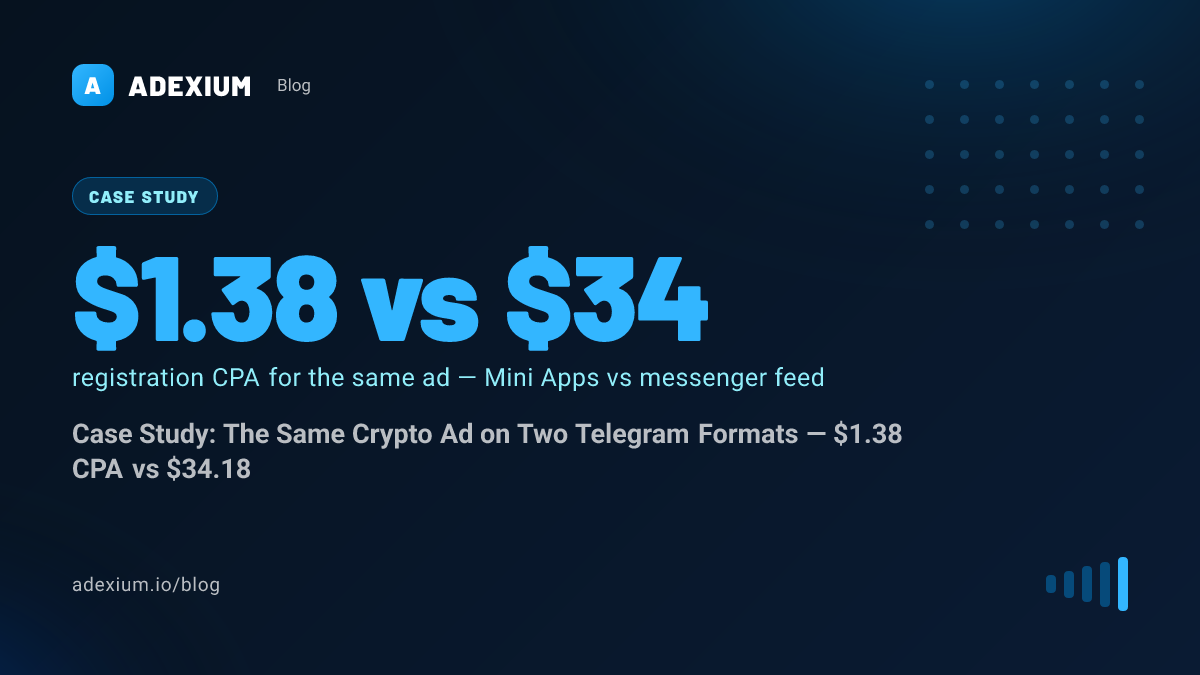
Advertisers ask which Telegram format is “better” all the time, and the honest answer is that the question is incomplete: better for what funnel. This case is about as close to a controlled experiment as live media buying gets — one advertiser, one geo, one offer, the same two ad angles, running simultaneously on two formats for ten weeks. Only the format varied.
The result: the format that took 88% of the budget produced 24% of the registrations.
The setup
A tap-to-mine crypto app promoted to a United States audience. The ad deep-links straight into the advertiser’s Telegram Mini App; the user registers there, and the advertiser’s platform takes over from that point. Registrations come back to us by S2S postback with the click ID, so every campaign row carries a real CPA rather than a click-count guess.
| Setting | Value |
|---|---|
| Offer | Tap-to-mine crypto app (Telegram Mini App funnel) |
| Geo | United States |
| Conversion | Registration inside the advertiser’s Mini App, tracked by click ID |
| Formats | Telegram Mini Apps (TMA) and iMe Messenger |
| Creatives | Two static angles, identical copy on both formats |
| Period | 28 May – 7 August 2026 (10 weeks) |
| Total spend | $926.92 |
The two angles ran as separate campaigns per format — “The infrastructure runs. You accumulate.” and “There’s more than one way to play it.” Same headlines, same static-image treatment, same landing destination on both formats. That symmetry is what makes the comparison worth publishing.
The scoreboard
| Metric | Telegram Mini Apps | iMe Messenger |
|---|---|---|
| Impressions | 33,333 | 733,493 |
| Clicks | 5,151 | 4,999 |
| CTR | 15.45% | 0.68% |
| Spend | $106.65 | $820.27 |
| Share of budget | 11.5% | 88.5% |
| Registrations | 77 | 24 |
| CPA | $1.38 | $34.18 |
Read the first two rows together, because that pairing is the whole lesson. iMe served 22x more impressions and produced essentially the same number of clicks — 4,999 against 5,151. Everything the volume bought evaporated between the impression and the tap.
Then it evaporated a second time further down. Click-to-registration ran at 1.50% on Mini Apps and 0.48% on iMe — so the clicks that did arrive from the messenger feed were also worth about a third as much each. Two multiplicative losses stacked into a 25x CPA gap.
The cheap-CPM trap
The reason 88% of the budget ended up in the weaker format isn’t carelessness. It’s that iMe looked like the bargain on every metric a dashboard shows before conversions land:
| Telegram Mini Apps | iMe Messenger | |
|---|---|---|
| CPM paid | $3.20 | $1.00 – $1.22 |
| Effective cost per click | $0.021 | $0.164 |
iMe inventory cost roughly a third of the CPM — and, because almost nobody clicked, 8x more per actual click. A cheap CPM is a discount on attention you have not yet proven exists. Until a conversion event is wired up, the buyer is optimizing toward whichever format sells impressions most cheaply, which is the opposite of what they want.
The paired test, angle by angle
Both angles ran on both formats, so the comparison holds inside each creative as well as in aggregate:
| Angle | Format | Impressions | Clicks | CTR | Spend | Regs | CPA |
|---|---|---|---|---|---|---|---|
| ”The infrastructure runs…” | TMA | 14,024 | 2,450 | 17.47% | $44.87 | 28 | $1.60 |
| ”The infrastructure runs…“ | iMe | 313,918 | 2,109 | 0.67% | $316.76 | 12 | $26.40 |
| ”There’s more than one way…” | TMA | 19,309 | 2,701 | 13.99% | $61.78 | 49 | $1.26 |
| ”There’s more than one way…“ | iMe | 45,171 | 227 | 0.50% | $45.17 | 1 | $45.17 |
| Both angles | iMe | 374,338 | 2,663 | 0.71% | $458.28 | 11 | $41.66 |
The winning angle on Mini Apps is also the winning angle on iMe in relative terms — creative quality carries across formats — but the level is set by the format. The better creative on the wrong format still lost to the worse creative on the right one by a factor of 20.
What the account did next
Nothing about this was obvious in week one. Watch the correction happen month by month:
| Month | iMe spend | iMe regs | iMe CPA | TMA spend | TMA regs | TMA CPA |
|---|---|---|---|---|---|---|
| May (from 28th) | — | — | — | $5.02 | 4 | $1.26 |
| June | $663.23 | 17 | $39.01 | $21.30 | 18 | $1.18 |
| July | $128.60 | 7 | $18.37 | $46.83 | 43 | $1.09 |
| Aug 1–7 | $28.45 | 0 | — | $33.50 | 12 | $2.79 |
June is the month that pays for the lesson: $663 and 17 registrations on iMe against $21 and 18 registrations on Mini Apps. Nearly identical output, 31x the cost. Once that showed up in the CPA column, spend moved — iMe fell from 97% of the month’s budget in June to 46% in the first week of August, and July delivered the account’s best month: 43 registrations at $1.09 on a budget smaller than what June burned on iMe in two days.
Why the gap is this wide
Three structural reasons, all about funnel fit rather than about one format being “bad”:
- Zero context switch on Mini Apps. The user is already inside a Mini App when the ad appears, and the destination is another Mini App. The click and the “install” are the same gesture. A messenger-feed impression asks the user to leave a conversation and start something — a much larger ask for a tap-to-earn product.
- The placement does the targeting. People inside Mini Apps at that moment are self-selected Mini App users: payment-enabled, tap-to-earn literate, one tap from the funnel. A messenger audience is everyone.
- Reach formats and response formats have different jobs. iMe bought three-quarters of a million impressions for $820 — that is genuinely cheap reach, and for objectives measured in reach it prices accordingly. It just isn’t a direct-response channel for an in-Telegram registration funnel, and no bid tuning fixes a mismatch of intent.
We have seen the same ranking in an unrelated vertical: in our VPN case study, TMA campaigns clicked between 7.5% and 20.5% while a comparable iMe Messenger line sat at 0.14%. Whenever the funnel closes inside Telegram, Mini Apps placements outperform feed placements by an order of magnitude or more.
Takeaways
- Split by format from day one. This entire finding cost $926 to learn only because the campaigns were already separated. Blended into one line, the account would have reported a $9.18 blended CPA and no way to see the $1.38 hiding inside it.
- Impressions are the least informative column in the dashboard. 95.6% of this account’s impressions produced 24% of its outcomes.
- Price your traffic per click and per conversion, never per mille. CPM comparisons across formats are comparisons of inventory supply, not of buying efficiency.
- Wire conversions before you scale, not after. Everything above is invisible without a postback; the June bill is what “we’ll add tracking later” actually costs.
- Don’t generalize a format verdict past your funnel. This is one advertiser, one geo, one conversion event. The transferable rule is the method — same creative, split formats, judge on CPA — not the verdict.
Crypto and tap-to-earn Mini Apps run on Adexium’s TMA inventory with bot and Mini App deep-linking, click-ID attribution and S2S postbacks out of the box. Split your next test by format and let the CPA column pick the winner.