VPN is one of the most natural verticals for Telegram Mini Apps traffic: the user is already on a phone, already values private messaging, and can complete the entire funnel (bot start, trial, paid subscription) without leaving Telegram. Two real Adexium cases from this vertical: one about finding the right message, and one where the proof of quality came from the client’s own analytics, not our dashboard.
Mini-case 1. Three angles, one offer, an 8.09% CR winner
A VPN advertiser ran the same product on Adexium TMA inventory with three different messaging angles as separate campaigns:
- Broad: general privacy/access pitch, wide audience;
- Work & content: “access the content and tools you need”;
- Power users: a pitch aimed at tech-savvy “specialist” users.
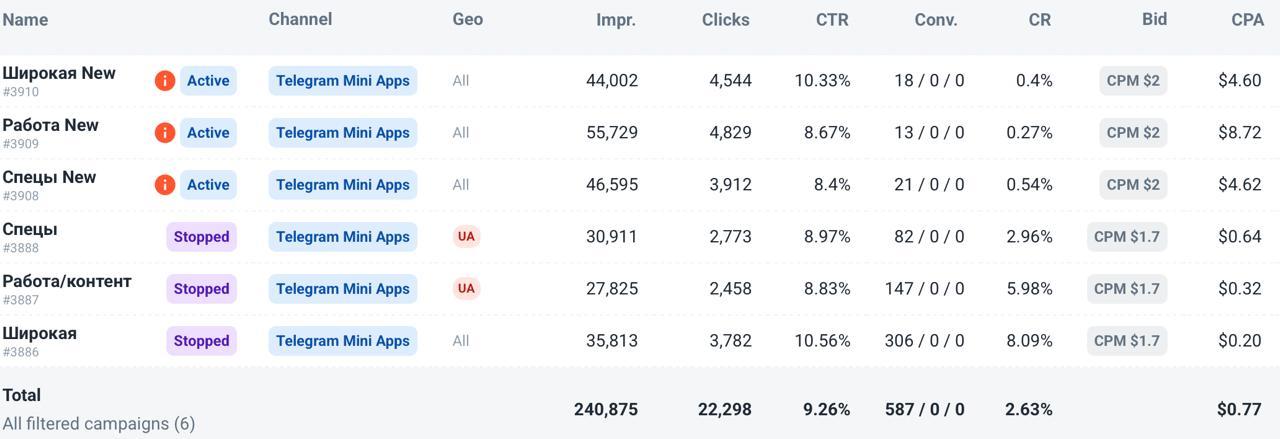
All three tracked subscriptions via postback. The full account, including a later relaunch (more on that below):
The original test, at a $1.7 CPM:
| Angle | Impressions | CTR | Conversions | CR | CPA |
|---|---|---|---|---|---|
| Broad | 35,813 | 10.56% | 306 | 8.09% | $0.20 |
| Work & content | 27,825 | 8.83% | 147 | 5.98% | $0.32 |
| Power users | 30,911 | 8.97% | 82 | 2.96% | $0.64 |
Two things worth staring at:
- CTR was useless as a ranking signal. All three angles clicked within a 1.7-point band (8.8–10.6%); TMA users click generously. But conversion rate spread 2.7x, from 2.96% to 8.09%. Without postbacks, this test would have concluded “everything works the same.”
- The broad angle won, which surprises people who expect narrow targeting to always win. In TMA, the inventory itself is the filter (users inside Mini Apps skew mobile-first and payment-enabled), so the widest message captured the most of an already-qualified audience.
Across the whole account the numbers came to 240,875 impressions, 22,298 clicks (9.26% CTR), 587 subscriptions at a $0.77 blended CPA.
The relaunch flopped
Months later the same three angles were relaunched (“New” rows in the screenshot) at a slightly higher $2 CPM and converted at $4.60–8.72 CPA, with CR collapsing from 8% to under 0.6%. Same offer, same angles, same format. The reachable audience pool had rotated, and the old creatives had been seen. The format did not stop working. A winning angle is a snapshot, not an annuity: re-validate winners with small budgets after every pause instead of scaling them on memory.
Mini-case 2. The client’s own dashboard as proof
Dashboard CPAs are our numbers. The stronger evidence is what the advertiser sees on their side. A different VPN client tagged each Adexium campaign with its own source parameter and pulled this from their internal analytics:
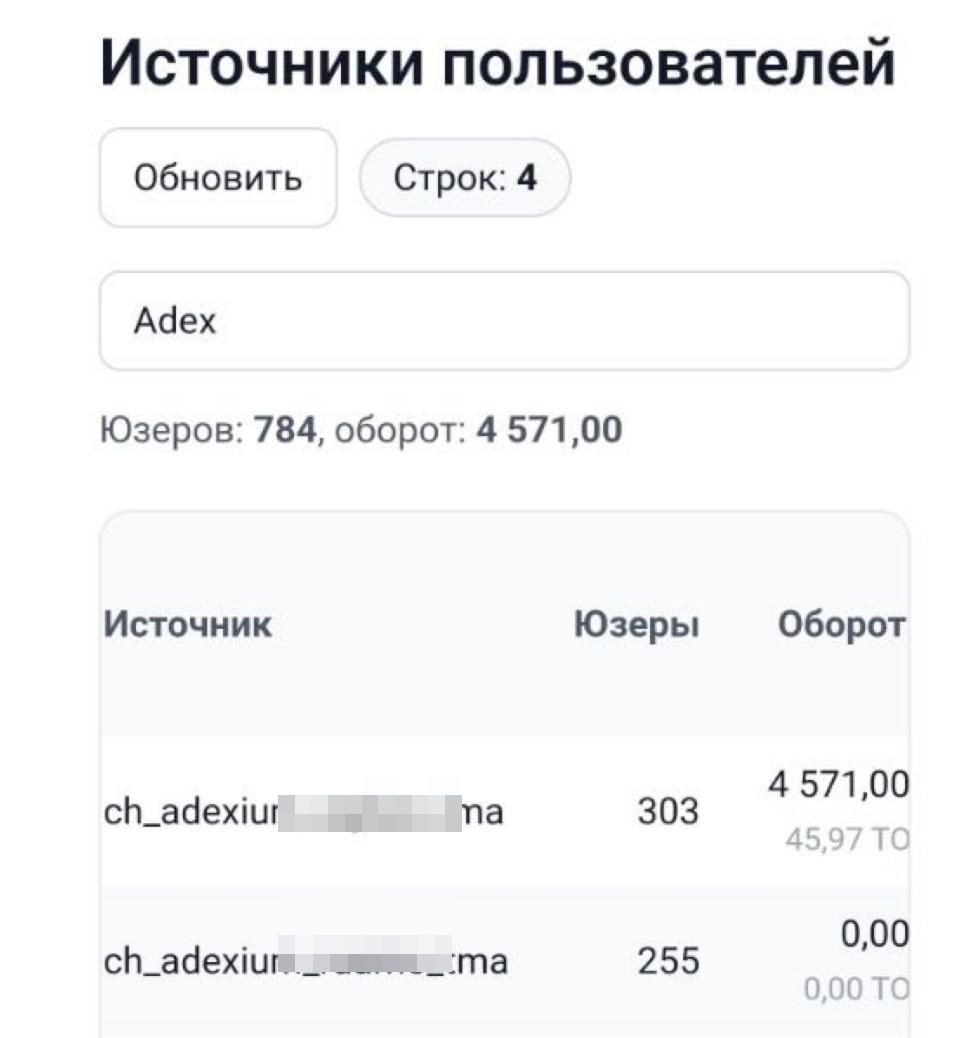
784 users arrived from Adexium-tagged sources, and one TMA campaign alone brought 303 users generating 4,571 in subscription turnover (≈46 TON), real revenue in the client’s books rather than a proxy metric. The second campaign’s 255 users produced no revenue in the same window, and that contrast is exactly why per-campaign source tags matter: the client could scale the paying source and rework the other based on their own money data, with zero attribution arguments.
What VPN campaigns look like in TMA overall
The same buyer’s account history across several VPN products shows the format’s typical click behavior, TMA campaigns clicking between 7.5% and 20.5% CTR (names blurred):
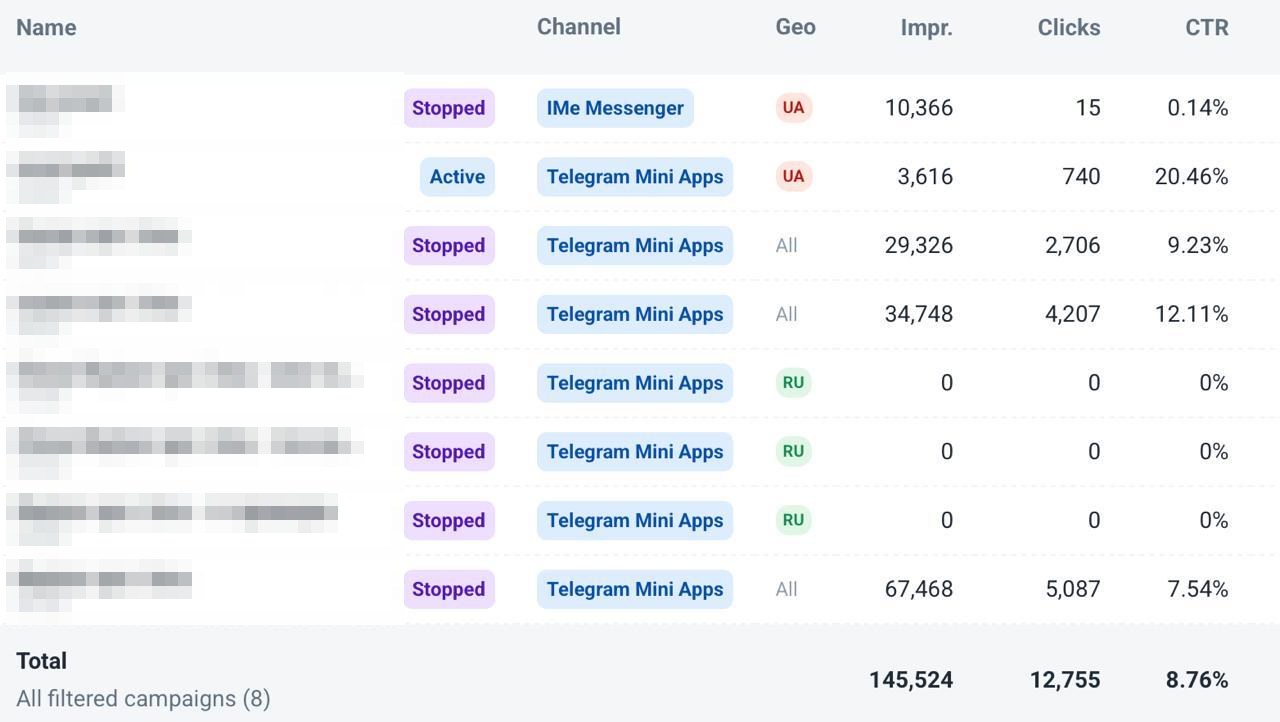
Note the one iMe Messenger row at 0.14% CTR: for VPN offers, where the funnel lives inside Telegram bots, Mini Apps placements dramatically out-click messenger-feed placements. Format-vertical fit is real.
Takeaways
- In TMA, test angles and judge them on CR. CTR differences were noise (8.8–10.6%); CR differences were the whole game (2.96–8.09%).
- Broad messaging can beat narrow targeting when the placement itself pre-qualifies the audience.
- Winners expire. The $0.20 angle came back at $4.60 after a pause. Re-validate before you re-scale.
- Give every campaign its own source tag so the client can verify revenue in their own analytics, the only attribution nobody disputes.
VPN offers run on Adexium’s Telegram Mini Apps inventory today at CPMs from $1.7, with S2S postbacks for in-bot conversion tracking. Launch an angle-split test; three campaigns and $100 are enough to find your 8% CR message.