The gap between “popunder doesn’t work” and “popunder is my cheapest channel” is usually one thing: source selection. This case shows that gap measured precisely, because two independent advertisers on Adexium ran the exact same experiment on Philippines popunder traffic, and got the exact same answer.
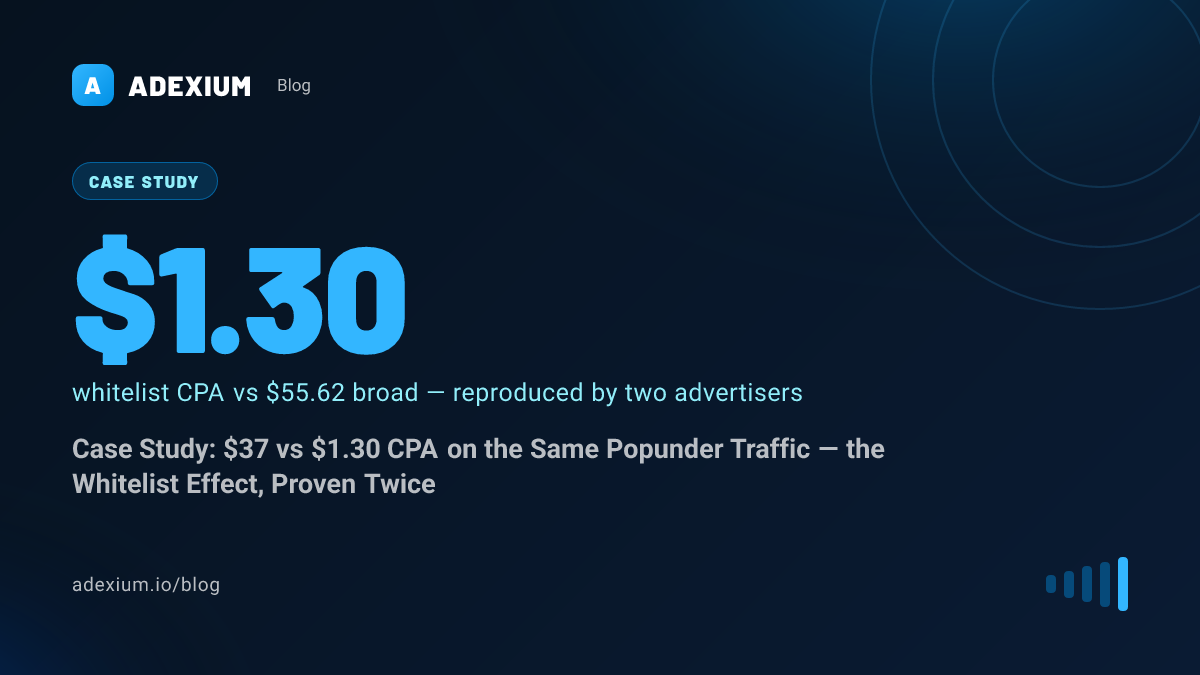
Both ran a broad campaign and a whitelisted campaign side by side, same offer type, same geo, same format, conversions tracked via postback. The broad buys converted at $37.52 and $55.62 CPA. The whitelisted buys converted at $1.72 and $1.30, a 20–40x difference on the same inventory pool, reproduced across two separate accounts.
Advertiser A, $37.52 broad vs $1.72 whitelist

| Campaign | Impressions | Conversions | CPA | Spend |
|---|---|---|---|---|
| PH_pop (broad) | 278,751 | 15 | $37.52 | $675.31 |
| PH_pop_WL (whitelist) | 3,122 | 5 | $1.72 | $10.34 |
| ID_pop (broad, Indonesia) | 53,119 | 1 | $42.76 | $85.52 |
Look at the volume asymmetry: the whitelist campaign bought 1% of the broad campaign’s impressions and produced a third of its conversions, for $10 instead of $675. The broad campaign wasn’t wasted money, though: it was the discovery run that found the placements the whitelist now buys.
Note the bids: the whitelist runs at $3.5 CPM versus $2.5 on the broad buy. Paying 40% more per thousand for known-converting placements, and getting a 20x cheaper conversion: the whole thesis in one row.
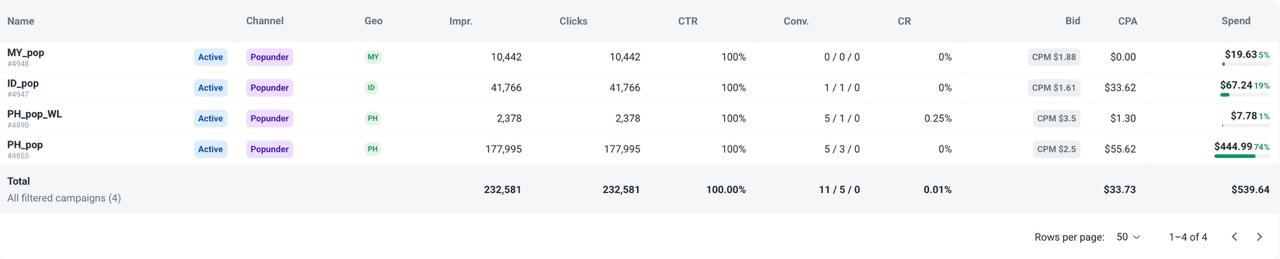
Advertiser B, $55.62 broad vs $1.30 whitelist
A different advertiser, same playbook, and the pattern reproduced almost exactly:
| Campaign | Impressions | Conversions | CPA | Spend |
|---|---|---|---|---|
| PH_pop (broad) | 177,995 | 5 | $55.62 | $444.99 |
| PH_pop_WL (whitelist) | 2,378 | 5 | $1.30 | $7.78 |
| ID_pop (broad, Indonesia) | 41,766 | 1 | $33.62 | $67.24 |
| MY_pop (broad, Malaysia) | 10,442 | 0 | — | $19.63 |
Here the whitelist matched the broad campaign’s conversion count outright, 5 vs 5, on 1.3% of the impressions and 1.7% of the spend. Same $3.5-over-$2.5 bid premium, same result.
One replication is an anecdote. Two independent accounts landing at $1.30–1.72 whitelist CPA against $37–56 broad CPA is a pattern you can build a media plan on.
Why the gap is this large in popunder specifically
Popunder is the format where placement quality varies the most. A pop from a site whose audience matches your offer intent behaves like cheap native traffic; a pop from a mismatched placement is a closed tab in under a second. Since every impression is a click (CTR is structurally 100%), there’s no CTR signal to pre-filter by. Conversion-per-placement data is the only quality signal that exists, which makes the discovery → whitelist loop mandatory rather than optional.
The Philippines amplifies this: it’s a high-volume, low-CPM geo (from $2.5 CPM here) with a very wide inventory pool, exactly the conditions where broad buys drown in placement noise and whitelists shine.
The playbook, step by step
- Launch broad at a moderate CPM with postbacks wired. Budget it as a data cost, not a profit line.
- Wait for placement-level conversions. In both accounts here, 15 and 5 broad conversions were enough to seed a working whitelist.
- Clone into a whitelist campaign, bid up ~40%. You’re now competing for exactly the impressions that convert, so win them.
- Don’t kill the broad line. Inventory rotates; the broad campaign keeps feeding new placements into the whitelist. Both advertisers keep both running.
Takeaways
- The whitelist effect reproduced across two independent accounts: $37–56 broad vs $1.30–1.72 whitelisted, same geo, same format, same period.
- In popunder, conversions-per-placement is the only quality signal. Budget the broad campaign as the price of that data.
- Bid premiums on whitelists pay for themselves immediately. +40% CPM for a 20–40x CPA improvement is not a trade-off, it’s free money.
- Tiny whitelist volumes are fine at this CPA. The scaling path is widening the whitelist through continued discovery, not loosening targeting.
Popunder traffic in the Philippines and 100+ other geos is live on Adexium, with per-placement stats and postback tracking, so you can run this exact playbook from a $100 deposit.