Most display advertising fights for attention against content the user actually came to see. Telegram Mini Apps ads for other Mini Apps are a different game: the ad audience is already inside a Mini App, one tap away from the next one. When the creative shows exactly what that next app feels like, click-through rates stop looking like display and start looking like recommendations.
This case is a tap-to-mine USDT app promoted on Adexium’s TMA inventory with a single vertical video creative. The scoreboard: 36.07% CTR and a 39.07% click-to-start conversion rate, 1,067 bot starts from 7,572 ad impressions.
The numbers

| Metric | Value |
|---|---|
| Impressions | 7,572 |
| Clicks | 2,731 |
| CTR | 36.07% |
| Conversions (bot starts) | 1,067 |
| CR (click → start) | 39.07% |
Multiply the funnel through: 14% of everyone who merely saw the ad ended up inside the advertiser’s bot. For context, a typical static in-page creative converts view-to-click in fractions of a percent. Lifetime, the same video creative held a 40.48% CTR across 71.6K views, so this is the creative’s steady state rather than a lucky small sample.
(Conversions here are bot starts, the top of the advertiser’s funnel, tracked via click ID. Deposit economics happen downstream in the app; what this campaign optimizes is the cheapest possible qualified start.)
The creative that did it
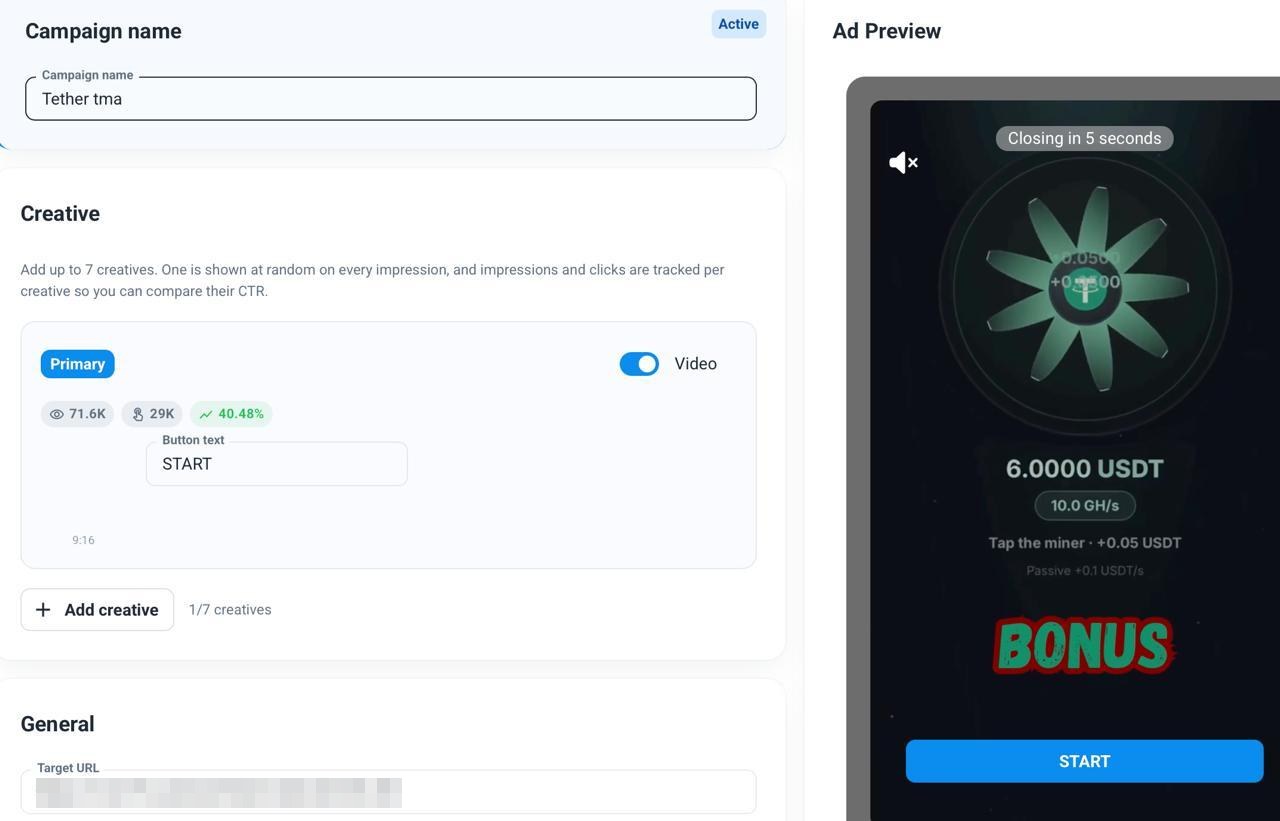
The whole setup is one video and one button, and every element is doing deliberate work:
- It’s a screen recording of the product, not an ad about the product. The video shows the actual miner spinning, the USDT balance ticking up, the bonus flashing. For five seconds, the viewer is effectively using the app. Clicking START continues something already started.
- The reward mechanic is on screen in numbers: balance, mining rate, “+0.05 per tap”, passive income rate, BONUS. Crypto-curious TMA users don’t need persuading about the category; they need to see this app’s numbers.
- 9:16 vertical video with sound off and a 5-second skip timer, native to how the placement is consumed, no horizontal letterboxing, no dead air.
- The button says START, and the link is a bot deep link (
t.me/…?start=with a click-ID macro). The ad’s promise and the landing experience are the same word. Every start is attributed back to the campaign, so the CPA column is real.
Why this vertical + format combo runs this hot
Three compounding effects:
- Zero context switch. The user is in Telegram, the product is in Telegram. No app store, no signup form, no browser: the “install” is a bot start, which is why click-to-conversion holds at 39% instead of leaking 90% like a typical mobile-app funnel.
- Audience self-selection. People inside Mini Apps at that moment are, by definition, Mini App users: payment-enabled, tap-to-earn literate. The placement does the targeting.
- Video as a free trial. In a vertical where every offer claims easy earnings, showing the mechanic beats claiming it. The creative de-risks the click.
Takeaways
- In TMA-to-TMA advertising, the best creative is the product itself. Record it; don’t art-direct it.
- A 36% CTR is achievable, but only when ad, placement and destination are one continuous experience.
- Deep-link with click IDs from day one. 1,067 attributed starts is an optimizable dataset; “lots of clicks” is not.
- Use per-creative stats. Adexium tracks impressions and clicks per creative (up to 7 in rotation), so the 40% lifetime CTR here is a measured fact you can manage against and replace the moment it fades.
Crypto and tap-to-earn Mini Apps run on Adexium’s TMA inventory with video creatives, bot deep-linking and click-ID attribution out of the box. Upload a screen recording of your app and see what your real CTR ceiling is.