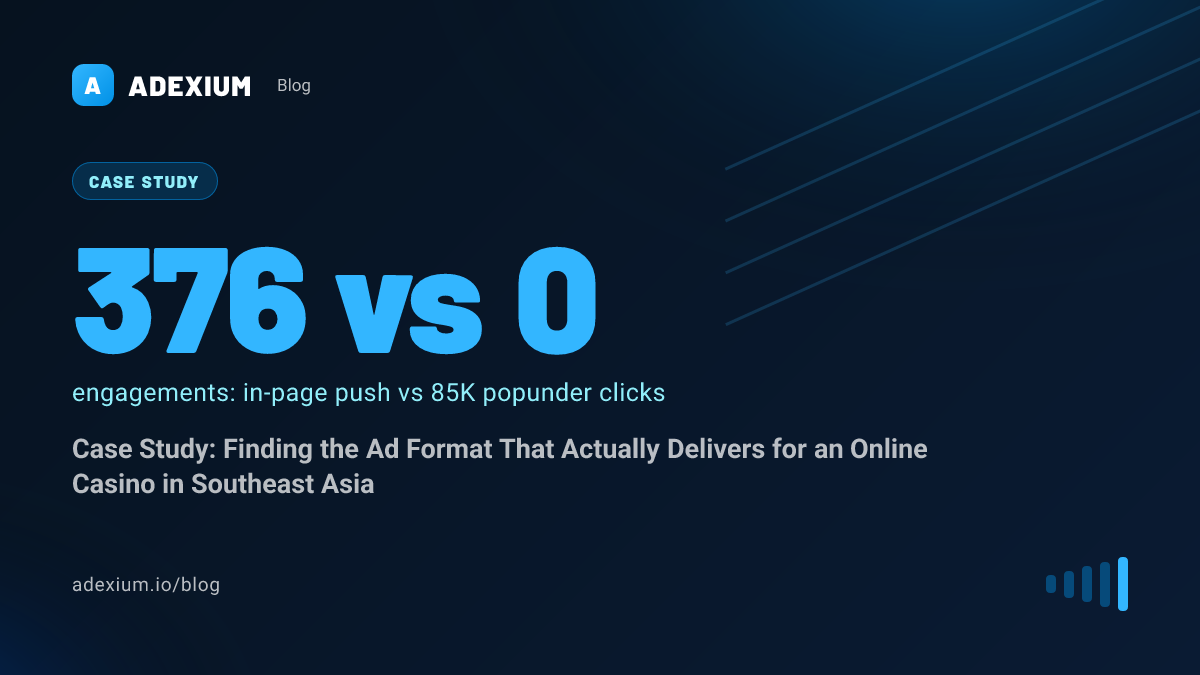
This is a teardown of a real campaign that ran on Adexium for an online casino brand targeting two Southeast Asian markets. The budget was modest, $100/day, and the setup is one we see all the time: several formats running at once, no conversion tracking, and a client who honestly couldn’t say which half of the spend was working.
The short version: the format everyone expected to win produced exactly zero engagement, and the cheapest clicks turned out to be the only ones doing anything. Without tracking, the budget would have kept flowing to the wrong place indefinitely.
The starting point
The client wanted to promote the casino across two SEA markets using three formats at once:
| Setting | Value |
|---|---|
| Offer | Online casino |
| Geos | 2 Southeast Asian markets |
| Budget | $100/day |
| Formats | Popunder, In-Page Push, Telegram Mini Apps (video + static) |
| Tracking | None |
That last row is the real problem. With no conversion or engagement data coming back, the only visible numbers are impressions, clicks and CTR. Comparing formats on those numbers alone leads to exactly the wrong conclusion.
Step 1. Split everything by format and geo
Instead of one blended campaign, we split the buy into six campaigns: popunder, in-page push, and TMA (video and static variants), each with its own budget line, so every format’s performance would be visible on its own row:
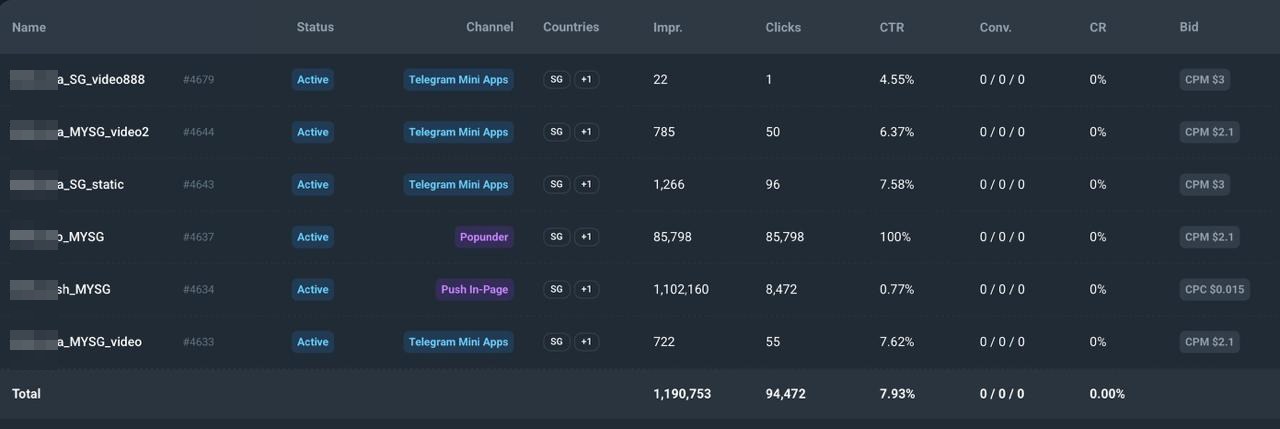
Reading the raw dashboard numbers:
| Campaign | Format | Impressions | Clicks | CTR |
|---|---|---|---|---|
| push_MYSG | In-Page Push | 1,102,160 | 8,472 | 0.77% |
| pop_MYSG | Popunder | 85,798 | 85,798 | 100% |
| tma_SG_static | TMA static | 1,266 | 96 | 7.58% |
| tma_MYSG_video2 | TMA video | 785 | 50 | 6.37% |
| tma_MYSG_video | TMA video | 722 | 55 | 7.62% |
If you judged this table on CTR, popunder looks unbeatable at “100%”. It isn’t: popunder registers a click for every impression by design (the click is the impression). That column tells you nothing about whether anyone actually engaged with the offer afterwards.
Step 2. Wire tracking so the funnel stops being a black box
The client couldn’t pass registrations or deposits back to us, so we set up per-campaign tracking links as a proxy for real interest: every campaign got its own link, and the landing side counted engagements, users who arrived and actually interacted, rather than bounced instantly.

And this is where the picture flipped:
| Campaign | Engagements |
|---|---|
| adx_push_MYSG (In-Page Push) | 376 |
| adx_MYSG_V2 (TMA) | 5 |
| adx_tma_SG (TMA) | 5 |
| adx_tma_MYSG (TMA) | 2 |
| adx_pop_MYSG (Popunder) | 0 |
Eighty-five thousand popunder “clicks” produced zero measurable engagement. Meanwhile in-page push, the format with the lowest CTR in the dashboard, delivered essentially all of the real activity.
Step 3. Cut and reallocate
The decision was mechanical at that point:
- Popunder: disabled. Zero engagement across the whole test. For this offer and geo pair, that traffic was noise.
- Weak TMA variants: disabled. The video creatives had healthy CTRs but single-digit engagement at tiny volume.
- In-Page Push: scaled. The full daily budget moved to the format with proven post-click activity, keeping the top TMA campaign as a secondary line.
Outcome
From $100/day of blind spend to a data-driven allocation where the client knows exactly which format delivers real users. Same budget, same offer, same geos, but now every dollar goes where the engagement is, and scaling is a decision instead of a gamble.
One honest caveat: “engagement” here is a proxy metric, not a deposit. The next step for this account is S2S postbacks on registration and first deposit, so optimization can run on revenue events instead of proxies. It takes about five minutes in the Adexium dashboard.
What to steal from this case
- Never judge popunder by CTR. It’s structurally ~100%. Judge it by what happens after the click.
- A $100/day budget is enough to find a winner if formats are split cleanly and something measurable comes back from the landing side.
- Cheap clicks that do nothing are the most expensive clicks you can buy. The popunder line looked like great value right until the engagement column loaded.
- If the client can’t set up postbacks, don’t wait; per-campaign tracking links take minutes and already separate signal from noise.
For the same teardown on your offer, launch a split-by-format test on Adexium. Minimum deposit is $100, and our team will help you wire tracking on day one.